
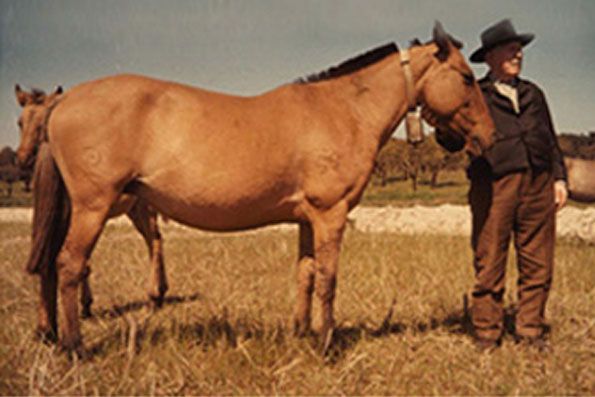
The Sorraia breed is autochtone from the south of the Iberian Peninsula, kept in a semi-wild environment. They are the primitive ancestors of many other breeds, namely the Pure Lusiano Blood (PSL), but its reduced number is far from being enough to save this breed from extinction.
“Later, in 1920, on a hunting trip in the region of Coruche, on the lower Sorraia (river), on the ‘Sesmaria’ estate, I saw a herd of ca. 30 individuals, more than half of them were light duns, some were grullas, many with superabundant stripes, and generally in all aspects absolutely wild, or primitive, as if they were a species of zebra, or a hemionus (halfass) species.”
Dr. Ruy D’Andrade
This was how the zoologist, anatomist, horse breeder and palaeontologist Dr. Ruy d’Andrade discovered this small horse, which was the primary ancestor of the famous horses of Andalusia and Lusitania and, both directly and indirectly, ancestor to many horses throughout Europe and the Americas. It is this horse that contributed the proud carriage, the ability to flex at the poll, to collect and to work off the hindquarters to these breeds, and via the Lusitano and the Andalusian to all modern warm blood breeds.
History
As Dr. Ruy d’Andrade found the last survivors of this sub-species in Portugal near the Sorraia River, he baptized them with this name.
He is also the responsible for their preservation: he saved the species by placing a small group on his estate near the Sorraia River, in Agolada de Baixo, and letting them multiply.
His studies convinced him that the Sorraia horse is not just a breed, but it represents the autochthone wild horse of southern Iberia that survived in the wild until the first quarter of this century.
When preserving the Sorraia horses, Dr. d’Andrade did not create a breed but he gave the last remaining individuals a sanctuary on his ranch. Rather than selectively breeding them, he kept them in a semi-wild state and allowed mother nature to be the determining factor by not feeding or supplementing these horses. As D’Andrade did not get any outcrops of other forms from his original seed stock, it can rightfully be assumed that they were of a pure breed. Also, there is a very old genetic type found in the Sorraia, different from other Iberian horses, its absolutely primitive phenotype and wild behaviour.
There is also a fact that the Sorraia has no history as a domestic breed.
Dr. Ruy D’Andrade’s extensive studies documented the Sorraia horse as a direct descendant of one of the four forms of primeval wild horses from which all our domestic breeds derived, namely form III, which inhabited the south of the Iberian Peninsula.
Dr. Ruy D’Andrade found conclusive evidence in the teeth of the Sorraia horses: “As is well known, teeth are among the most common archaeological findings. They allow precise conclusions regarding the evolutionary state of an animal and are the most reliable elements for a systematization.[…] The pure-bred Andalusian’s teeth, though, correspond with those of the Sorraia horse.”
Paintings of horses on the cave walls at La Pileta, near Ronda (Granada), in the south of Spain, officially dated between 30,000 and 20,000 B.C., already show the subconvex heads and arched necks typical of Andalusians, Lusitanos and their ancestor, the Sorraia, as do ancient sculptures.
All this suggests that the remaining Sorraias are a remnant population of a true wild horse form, or subspecies.
The total number of Sorraias in the world may not exceed 200 head, and they all stem from the original group of 7 mares and 4 stallions gadered by Dr. Ruy D’Andrade – that is how imminent the threat of inbreeding is!
Today, Sorraias are bred by a handful of private breeders, not only in Portugal, but also in Germany, France and Switzerland. Most are still owned by the D’Andrade family, who keeps them in semi-wild, where they born, grow and reproduce without human hand.
Beside all the efforts, the actual number of Sorraias is nowhere near a number that would ensure the survival of the most primitive Iberian horse we have today, making this a breed in extinction!
Breed
The Sorraia is noted for its ability to withstand extremes of climate, particularly dry, hot climates, and to survive on very little forage while at the same time maintaining its health. Its’ hardiness, as well at its agility and ability to collect and work in the bridle, once made the Sorraia highly valuable to local stockmen.
Too long-legged to be seriously considered a pony type, the Sorraia is a small horse, weighting about 1,43m. The Sorraia’s head is rather long and has a convex, or subconvex, profile, the eyes are set high, the ears are fairly long and not particularly curved.
The Sorraia is always dun or grullo in colour, with a dark face/muzzle area, black dorsal stripe from the mane to the tail, black-tipped ears, usually zebra stripes on the legs, and sometimes a stripe across the shoulders. The black mane and tail are fringed by lighter-coloured, often almost white, hair. The pure Sorraia does not have white markings, and does not show infusion of either Oriental or North European blood.
Sorraias have been used as mounts for the Portuguese vaqueiros (cowboys). Some have even been trained to perform at the highest level of dressage, and other to compete in carriage driving competitions.
In Agolada de Baixo mares and some males are kept wild, and some others are taught to be ridden and used on carriage driving just for leisure.
Useful links
Portuguese Association of the Sorraia Horse
Hearts in Nature – Horses Tracks – to visit Sorraia heards
 Andrade Horses